3 Ways LLMs Fail in Production (and How to Fix Them)
Ground LLMs in your Unified Ontology, enforce governance, and stop hallucinations, context gaps, and data leaks.
Blog
3 Ways LLMs Fail in Production (and How to Fix Them)
Ground LLMs in your Unified Ontology, enforce governance, and stop hallucinations, context gaps, and data leaks.
Top failures
Context, Hallucinations, Security
Common in enterprise
Fix
Unified Ontology + RAG
Ground responses in truth
Governance
Command Center
Audit & HIL control
Failure 1: No business context
Off-the-shelf LLMs know nothing about your products, customers, pricing, or internal processes. Asking “What’s the status of order #123?” yields generic answers because the model has no access to your operational truth.
Result: useless for most operational tasks where accuracy and context matter.
Failure 2: Hallucinations and inconsistency
LLMs generate plausible text, not verified facts. Without grounding, they invent policies, figures, or advice that sounds right but is wrong. In regulated workflows, this is unacceptable.
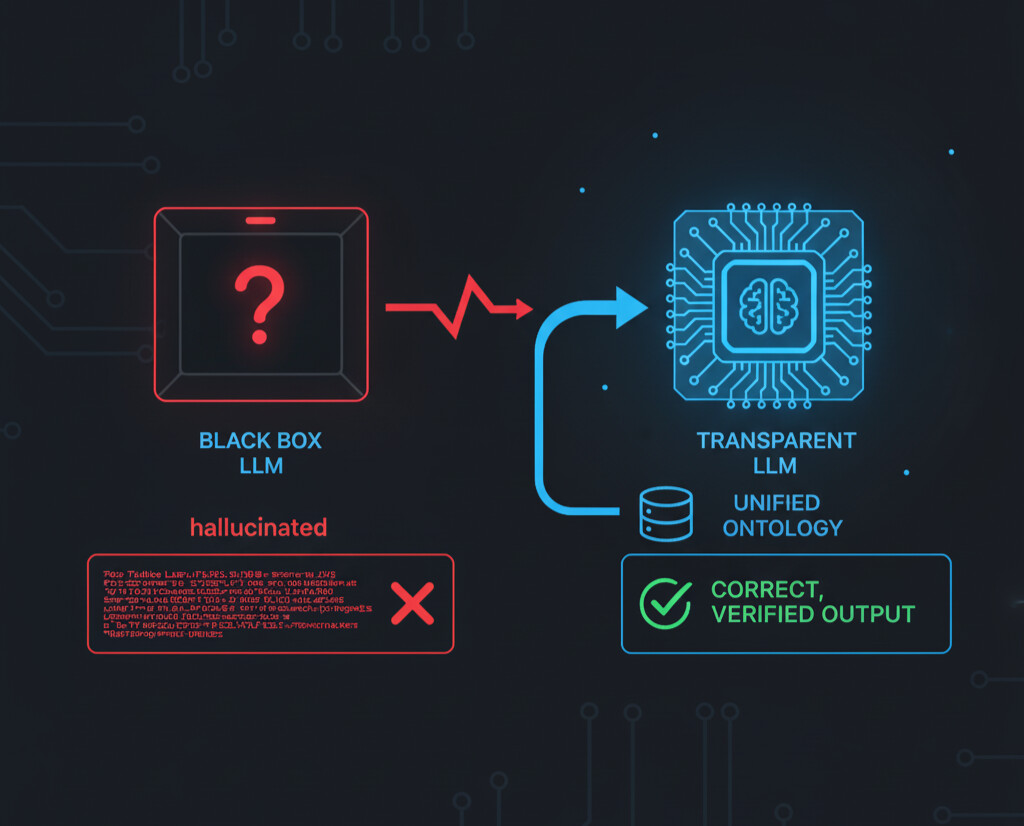
Fix: retrieve truth from a trusted source (Unified Ontology) before responding.
Failure 3: Security and data leakage
Sending proprietary data to public LLM APIs risks leakage. Prompts become someone else’s training set. Sensitive IP, financial data, or PII can escape.
Fix: keep data inside your boundary; ground on your own ontology; enforce policy-as-code and logging.
Approach: Ontology-grounded architecture
- Use the LLM as a language layer only; fetch truth from the Unified Ontology (RAG-style) first.
- Maintain lineage and auditability: every answer traceable to data, rules, and models.
- Human-in-the-loop via a command center; log prompts/responses for governance and safety.
What leaders should do next
- Ban public LLM use with proprietary data: Set clear policy.
- Invest in your ontology first: Model a high-value domain (products, customers, orders).
- Mandate ontology-grounded GenAI: Require RAG patterns for all enterprise LLM apps.
- Implement governance: Command center, logging, and human override baked in.