Beyond the Chatbot: Operationalizing Generative AI
Explore how to move Generative AI from simple chatbots to mission-critical intelligent agents that can automate complex workflows and provide expert-level insights.
Executive Summary
The first wave of enterprise Generative AI has been dominated by chatbots and copilots. While useful, these tools represent only a fraction of the technology's potential. The next, more valuable wave is "Operational GenAI"—the deployment of AI agents that can autonomously execute complex, multi-step business processes. This paper provides the architectural blueprint for moving beyond simple conversational interfaces to building a true cognitive workforce.
Why This Matters
The ROI of a chatbot is measured in saved minutes. The ROI of an autonomous operational agent is measured in millions of dollars of cost savings, risk reduction, and efficiency gains. Leaders who continue to view GenAI solely through the lens of conversational AI will miss the far larger opportunity to fundamentally re-architect their core business operations for an era of intelligent automation.
Key Insights
Insight 1: Chatbots Answer, Agents Act
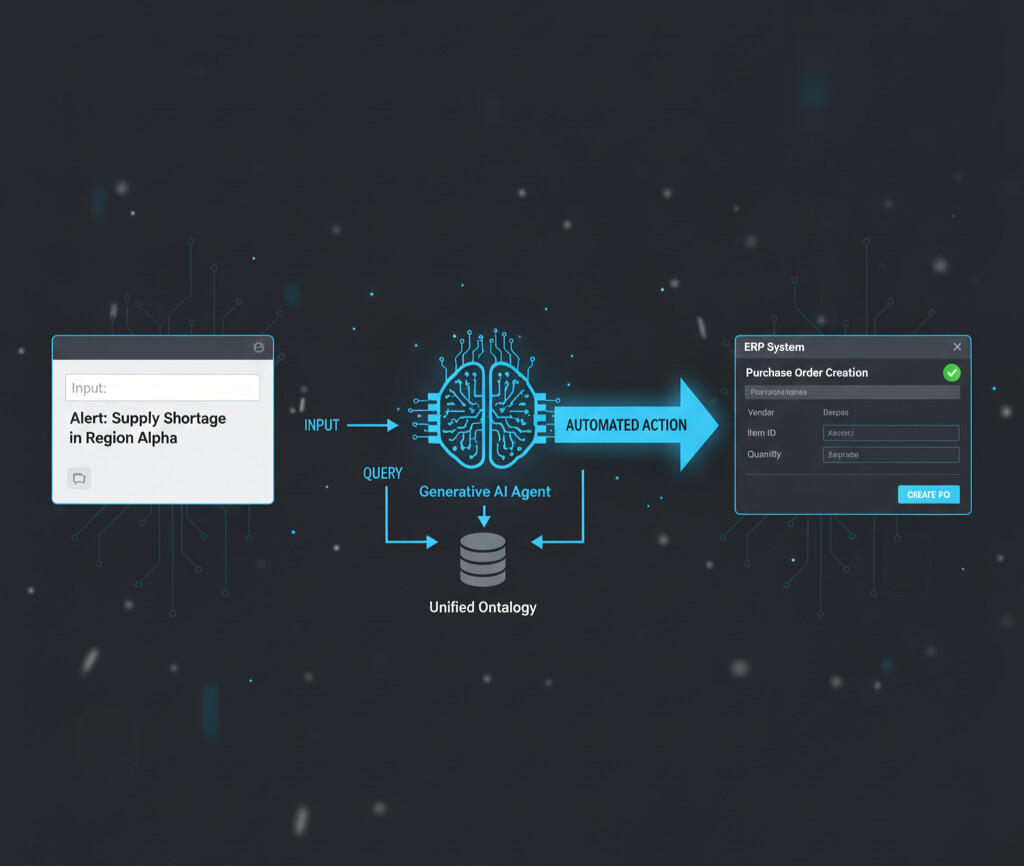
A chatbot's function is to synthesize information and answer a user's query. An operational agent's function is to achieve an outcome. For example, when a supply chain disruption occurs, a chatbot can summarize the alert. An operational agent can analyze the alert, model the impact on inventory, evaluate alternative shipping routes, and automatically book a new carrier—all in milliseconds.
Insight 2: Action Requires an Ontology and Tools
For an agent to act, it needs two things that a standard chatbot lacks: 1) A deep, contextual understanding of the business (the Unified Ontology), and 2) A secure, governed set of "tools" (APIs) it can use to interact with other enterprise systems (like an ERP or TMS). Without these, the agent is just a brain in a jar, unable to affect the real world.
Insight 3: The Architecture is a "Loop"
Operational GenAI is not a linear process; it's a continuous "Observe-Orient-Decide-Act" (OODA) loop. The agent observes a business event, orients itself using context from the ontology, decides on the optimal action using its reasoning and model-based logic, and then acts via its available tools. Every action creates new data that updates the ontology, making the entire system smarter over time. This requires a fundamentally different architecture from a simple request-response chatbot.
Architectural Perspective
At Akin, we see Generative AI as a powerful reasoning engine that sits at the heart of a Cognitive Agent. However, this engine is only effective when it is part of a larger, governed system. Our platform architecture explicitly provides the missing pieces: the Unified Ontology for context, the MLOps Engine for building and governing the agent's logic, and the Command Center for essential human-in-the-loop oversight. This transforms GenAI from a clever language tool into a trusted, operational component of the enterprise.
What Leaders Should Do Next
- Shift Focus from "Answers" to "Outcomes": Identify a core business process (e.g., invoice processing, order management) that is a candidate for end-to-end automation.
- Map the Required "Tools": Document the APIs and system integrations an agent would need to execute that process.
- Build the "Micro-Ontology": Define the core data entities and rules for that specific process to provide the agent with the necessary context.
- Design with Governance First: Architect the human-in-the-loop approval points and the audit trail for agent actions before deploying the first agent.
Akin’s Point of View
The true power of Generative AI will not be unlocked by building better chatbots, but by architecting a new cognitive workforce. The enterprises that win will be those that master the art of designing, deploying, and governing fleets of specialized AI agents that can execute their most critical business processes with speed, precision, and intelligence.
Have a Question About This Insight?
Our architects and researchers are always ready to discuss the future of enterprise intelligence. Let's start a conversation.