Beyond the Data Lake: The Case for an Operational Ontology
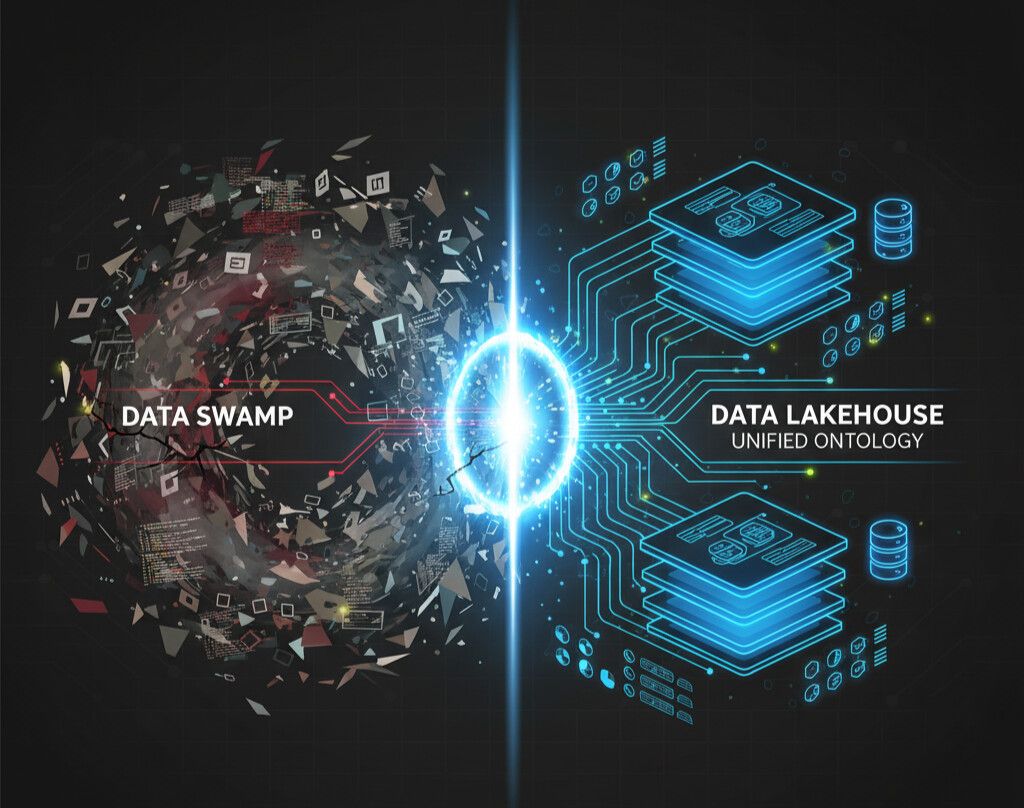
Data lakes become “data swamps” for operational AI. A Unified Ontology provides the real-time, governed foundation enterprises need.
Whitepaper
Beyond the Data Lake: The Case for an Operational Ontology
Data lakes become “data swamps” for operational AI. A Unified Ontology provides the real-time, governed foundation enterprises need.
Where time goes
Data preparation
Cleaning and merging before analysis
Top blocker
No semantic context
Across ERP/WMS/TMS silos
Priority shift
Unified Ontology
Foundation for AI at scale
Challenge: Data lakes lack semantic context
Data lakes store files and tables but don’t know what the data means. “Customer” in CRM vs “shipper” in logistics vs “account” in ERP remain disconnected, forcing humans to reconcile context manually.
Without a shared semantic model, teams spend the majority of time cleaning, joining, and guessing intent—leading to inconsistent models and unreliable AI outputs.
- Multiple IDs for the same entity across systems.
- No shared business definitions; conflicting metrics.
- Slow, manual reconciliation that never scales.
Challenge: Built for analytics, not operations
Batch ETL and slow refresh make lakes fine for historical reporting but useless for real-time decisions. Cognitive agents can’t prevent fraud or reroute shipments on 24-hour-old data.
Operational AI requires event-driven, real-time state with inherent governance—something a raw lake cannot provide.
Approach: The Unified Ontology as the intelligent core
- Semantic context: Shared language for entities and relationships (customers, products, assets, shipments).
- Real-time state: Fed by event streams, not just batch ETL.
- Inherent governance: Quality and rules enforced on ingestion; auditability by design.
- API-first: Consistent contract for apps, analytics, and AI agents to consume/live-update state.
What leaders should do next
- Shift mindset from storage to understanding: Build a shared ontology, not just bigger storage.
- Start with a high-value domain: Pick a critical slice (product, customer, shipments) to model first.
- Adopt API-first, event-driven patterns: Stream real-time updates into the ontology.
- Appoint an ontology owner: Treat the ontology as a product with clear ownership and governance.